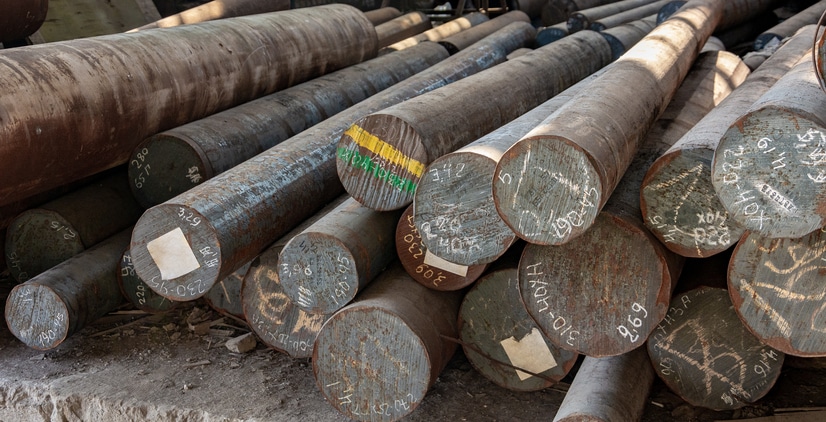
When specifying steel for a demanding application, the alloy you choose affects not only performance…

What ASTM A29 Means for 4140 Standards
Purchasing steel bars for industrial applications requires verification that the material can withstand expected mechanical loads, wear, and thermal stress. To ensure precise chemical, mechanical, and dimensional consistency across global suppliers, ASTM International establishes standardized manufacturing baselines.
Among commercial alloys is 4140 steel, often specified under the designation ASTM A29 4140, which is widely used for its versatile strength, deep hardenability, and high torsional strength. Understanding how ASTM A29 governs material standards and heat treatment guidelines allows engineering and procurement teams to select the ideal alloy steel for critical applications.
What is ASTM A29?
ASTM A29 serves as the overarching standard specification for general requirements governing alloy steel and carbon steel bars, covering hot rolled, cold rolled, rough turned, bright polished, and forged finishes. Rather than defining a single chemistry, ASTM A29 acts as a foundational baseline that specifies manufacturing tolerances, surface inspection criteria, testing methodologies, and dimensional limits for a wide variety of bar steels, including 4140 alloy steel.
When a supplier certifies that a bar meets ASTM A29, it guarantees that the manufacturing process adheres to strict quality controls regarding chemical composition limits, outer diameter consistency, overall straightness, and surface quality conditions.
Scope and Dimensional Limits
Under the ASTM A29 guidelines, standard bar sizes cover a broad operational range:
- Outer Diameter: Outer diameters typically range from 5 millimetres (0.197 inches) up to 500 millimetres (19.68 inches).
- Length Range: Standard mill production lengths generally span from 100 millimetres to 6,000 millimetres (6 metres), with custom cutting available for specific production lines.
- Surface Condition: Bars can be supplied in varied conditions, including hot rolled for heavy forging, cold rolled or cold drawn for tight dimensional accuracy, or rough turned to remove surface decarburization.
While ASTM A29 provides these baseline specifications, mills can produce custom sizes, non-standard shapes, and pre-machined profiles that fall outside standard dimensional tables while maintaining compliance with chemical and testing directives.
Quality Assurance and Material Certification
Beyond physical dimensions, ASTM A29 mandates full material traceability. A certified raw materials certificate (or Mill Test Report) must accompany ASTM A29 stock to prove compliance. This document details:
- The exact heat number tracking the steel back to its original melt ladle.
- Complete ladle chemical analysis.
- Macroetch testing results to verify the internal grain structure and rule out severe inclusions or voids.
- Compliance with dimensional tolerance tables.
This level of standardization guarantees that when you order ASTM A29 4140 from different mills, the core performance characteristics will remain uniform, simplifying tooling setup and processing schedules in your shop.
ASTM A29 Specification for 4140 Steel Bars
To understand what ASTM A29 means for 4140 standards, one must evaluate the chemical composition, mechanical metrics, and thermal responses specified by the combined standards.
Chemical Composition
The chemical balance of 4140 steel is designed to provide maximum hardenability, high fatigue strength, and good abrasion and impact resistance. The presence of chromium and molybdenum transforms simple carbon steel into a medium-carbon alloy steel capable of deep through-hardening during heat processing.
The standard ladle chemical limits required by ASTM A29 for 4140 steel are:
| Element | Weight Percentage (%) | Operational Role |
| Carbon (C) | 0.38 0.43% | Core element providing strength and hardness; higher than lower carbon grades to enable deep hardening. |
| Manganese (Mn) | 0.75 – 1.00% | Increases hardenability and tensile strength while aiding deoxidation during steelmaking. |
| Chromium (Cr) | 0.80 – 1.10% | Enhances corrosion resistance, high-temperature strength, and deep hardness penetration. |
| Molybdenum (Mo) | 0.15 0.25% | Prevents temper brittleness, refines grain structure, and significantly improves impact resistance. |
| Silicon (Si) | 0.15 0.35% | Acts as a principal deoxidizer and boosts elasticity and strength. |
| Phosphorus (P) | ≤ 0.035% | Strictly capped to prevent cold-shortness (embrittlement at room temperatures). |
| Sulfur (S) | ≤ 0.040% | Kept low to ensure high ductility and toughness, though slight additions can improve machinability. |
Compared to steels with low carbon content, the moderate carbon range (0.38 0.43%) allows 4140 to form a fully martensitic structure when quenched, giving it exceptional mechanical characteristics for heavy-duty operational environments.
Mechanical Properties
In its raw or annealed condition, ASTM A29 4140 displays excellent ductility and moderate strength, facilitating cost-effective machining, milling, and turning operations before final hardening.
The baseline standard mechanical properties for ASTM A29 4140 in its supply state include:
- Tensile Strength: ~95,000 psi (655 MPa / 95 ksi)
- Yield Strength: ~60,200 psi (415 MPa / 60.2 ksi)
- Elongation at Break: 25.7% (in 50 mm / 2 inches)
- Reduction of Area: 56.9%
- Brinell Hardness: 197 HB (Equivalent to approximately hardness Rockwell B 92 / Rockwell B 92)
- Machinability Rating: 65% (rated against 1212 carbon steel as a 100% baseline)
- Elastic Modulus & Modulus: Elasticity of ~205 GPa with a Poisson’s ratio typically between 0.27 and 0.30.
For engineering comparison purposes, these base numbers represent 4140 prior to thermal hardening. When evaluated in its fully heat-treated condition, the tensile strength can exceed 150,000 psi (1,030 MPa) with a surface hardness reaching well over 50 Rockwell C (HRC), making it vastly superior to standard mild steels.
Heat Treatment Guidelines for 4140 Alloy Steel
Heating steel is necessary for forging, annealing, normalizing, or hardening. Thermal processing is the primary method used to unlock the mechanical potential of 4140 steel, altering the material’s microstructural phases without introducing cracks or internal voids.
Processing Parameters
When you heat steel alloy bar stock, the heating rate, soaking duration, and cooling medium must be closely monitored to manage thermal expansion and phase transformations.
- Forging: Heat the steel carefully to a uniform temperature range between 1,150 °C and 1,200 °C. Maintain heat until the core is fully equalized. After completing the forging operation, allow the material to cool slowly in warm sand, dry lime, or an insulated furnace to avoid thermal stress cracking.
- Annealing: Heat to 800 °C – 850 °C, hold for one hour per inch of material thickness, and cool inside the furnace at a controlled rate (typically less than 20 °C per hour) down to ~600 °C before air cooling. This creates a soft, ductile annealed condition ideal for severe cold deformation or deep cold working.
- Normalizing: Heat between 870 °C and 900 °C, hold to fully transform the structure to austenite, then cool in still air. Normalizing uniformizes the grain structure, breaks up segregation, and relieves internal stress built up during prior hot work.
- Hardening: Heat to 840 °C – 875 °C, ensure complete soaking, and quench in oil or agitated polymer solution.
- Tempering: Immediately follow quenching with tempering between 150 °C and 600 °C, soaking for a minimum of two hours, followed by air cooling.
The Step-by-Step Hardening Process
To achieve high hardness, excellent wear resistance, and high fatigue performance in finish-machined components, execute the hardening sequence as follows:
- Uniform Heating: Elevate the 4140 alloy steel component slowly to ~850 °C–900 °C. Pre-heating in stages (e.g., stopping at 550 °C) is recommended for complex geometries to prevent thermal shock distortion.
- Soaking: Hold the steel at the target hardening temperature to transform the ferrite-cementite microstructure into uniform austenite, ensuring complete dissolution of carbides.
- Quenching: Rapidly submerge the part into a controlled bath of oil or liquid polymer. Rapid cooling transforms the austenite into hard, brittle martensite. Quenching in water is generally avoided for 4140 due to the high risk of quench cracking.
- Tempering: Martensite in its as-quenched state is too brittle for operational use. Tempering relieves internal stress and restores ductility. Reheating to 200 °C produces a high hardness level around 50–54 HRC for wear parts, whereas tempering at 550 °C yields a normal HRC range of 28–32 HRC optimized for structural strength and impact resistance.
- Post-Weld Heat Treatment (PWHT): If structural repairs or assembly welding occur, a post weld heat treatment (stress relief at 600 °C – 650 °C) is required. Welding untempered 4140 creates hard, brittle zones susceptible to hydrogen-induced cracking; PWHT relieves internal stress and softens the heat-affected zone (HAZ).
Key Applications of ASTM A29 4140 Steel Bars
Because ASTM A29 4140 provides a flexible mix of torsional strength, mechanical toughness, and surface hardenability, it is a key material across multiple industrial sectors.
Automotive and Transportation
Vehicle power trains rely heavily on 4140 for continuous power transfer under heavy dynamic loads.
- Axle Shafts & Crankshafts: High torsional strength ensures shafts withstand severe torque spikes without twisting or experiencing fatigue failure.
- Transmission Components & Gears: Case-hardened or nitrided 4140 gear teeth offer high resistance to pitting, abrasion, and tooth shear.
- Connection Rods: Excellent fatigue limit enables high-RPM operation under cyclic combustion loading.
Energy, Oil, and Gas Exploration
Subsurface extraction tools operate under high pressure, corrosive fluids, and extreme mechanical shocks.
- Drill Collars & Drill Stem Elements: Heavy-wall 4140 tubing delivers the weight and bending resistance needed for directional drilling.
- Hydraulic Shafts & Pump Shafts: High yield strength prevents bending in high-pressure fluid displacement pumps.
- Motor Shafts & Guide Rods: Heat-treated 4140 resists surface scoring and bending under heavy rotative loads.
Construction, Heavy Equipment, and Infrastructure
Large-scale engineering projects require high structural yield capacity and ease of maintenance.
- High-Strength Fasteners & Bolts: Heavy anchor bolts and structural tie rods made from 4140 withstand high tensile loads without stretching.
- Conveyor Pins & Pinch Bars: Excellent abrasion and impact resistance limits pin wear in aggregate handling systems.
- Infrastructure Projects: Tie rods, concrete tensioning blocks, and structural pivot pins in bridges and heavy dam gates rely on 4140’s high strength-to-weight ratio.
General Machinery and Tooling
Industrial production machinery utilizes 4140 for precision rotary and clamping tools.
- Lathe Spindles & Milling Spindles: High dimensional stability and minimal runout under high thermal loading.
- Chuck Bodies, Tool Holders, & Ejector Pins: Tough core strength prevents cracking during heavy tool clamping and continuous reciprocating movements.
Buy Your ASTM A29 4140 Steel Bars From Specialty Steel
Selecting the correct grade of steel is only half the battle; securing high-quality material backed by reliable traceability is equally critical. At Specialty Steel, we stock and process a comprehensive inventory of 4140 steel bars manufactured to strict ASTM A29 standards.
Whether your job requires hot rolled construction stock, cold rolled precision bars, rough turned forging blanks, or bright polished shafting, we supply material in rounds, hexes, flats, and other shapes. Every bar in our inventory comes with a full raw materials certificate, detailing melt origins and chemical test results for complete quality assurance.
With over 40 years of industry experience, Specialty Steel offers value-added services including precision saw cutting, custom heat treating, and specialized surface finishing. By receiving pre-sized and pre-treated steel tailored to your precise specifications, your shop can reduce machining cycle times, lower tooling costs, and complete critical applications ahead of schedule.
Order your ASTM A29 4140 steel bars today, or contact our technical sales team for guidance on selecting the ideal heat-treated condition for your next project!
Frequently Asked Questions (FAQs)
What Specific Surface Defects Does ASTM A29 Require Manufacturers To Inspect And Limit On 4140 Bars?
ASTM A29 establishes strict quality thresholds regarding surface seams, laps, slivers, decarburization, and scale pits. Manufacturers perform non-destructive tests (such as magnetic particle inspection or ultrasonic testing) to ensure these surface imperfections do not exceed standardized depth tolerances, preventing crack propagation during machining or final heat treatment.
Due to its molybdenum content, 4140 maintains good creep resistance and mechanical strength up to approximately 425 °C (800 °F). Beyond this threshold, prolonged exposure to high heat causes tempering soft spots, reducing yield strength and accelerated scaling, which makes higher-alloy stainless or nickel-based metals preferable for extreme high-temperature service.
Because 4140 is a low-alloy steel containing only 0.80–1.10% chromium, it lacks sufficient passive film protection and will corrode easily when exposed to moisture. Unhardened bar stock should be stored indoors under controlled humidity, coated with light slushing oil or rust-preventative petroleum compounds, and kept off concrete floors using wooden dunnage to block moisture transfer.
Related Posts