When specifying steel for a demanding application, the alloy you choose affects not only performance…

Best Practices for Machining 4140 Alloy Steel
When it comes to performance and versatility, 4140 alloy steel stands out as a top-tier material. Known for its strength, durability, and machinability, it’s a preferred choice across many industrial applications.
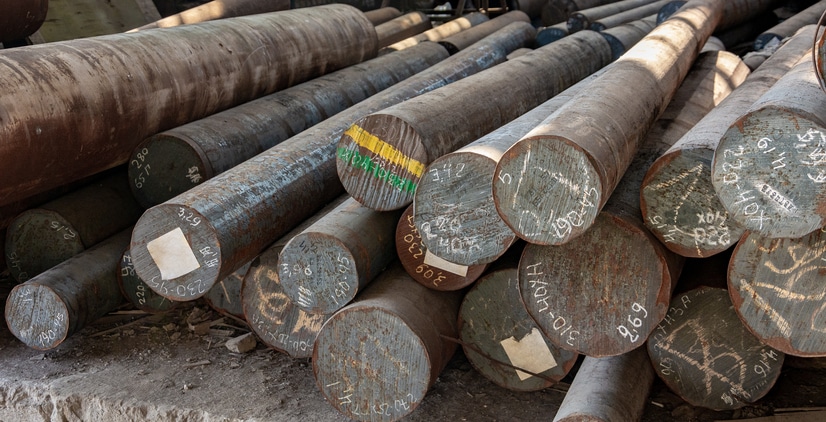
However, even though this type of steel is highly reliable and cost-effective, it often needs to be machined to meet specific project requirements. Whether you’re starting with plates, round bar, or square bar, machining ensures the material fits your exact specifications.
Improper machining can lead to warping, brittleness, and excessive tool wear—issues that slow down production and increase costs. Below, we’ll walk through the best practices for machining 4140 alloy steel, including recommended cutting speeds, tooling tips, and more.
Machining Alloy Steel: Anneal or Not to Anneal?
Broadly speaking, annealing is heating a metal until it becomes somewhat soft, while hardening means heating a metal specifically to make it tougher. Annealed metal is not only easier to machine, but the process “resets” the metal’s crystalline structure, making it stronger and more resilient once it cools.
Ideally, you should anneal this type of steel before machining to remove imperfections and reduce the amount of wear and tear on the metal and your tools. However, if that’s not possible, the steel is still relatively easy to machine when you follow the right methods.
Best Practices for Machining 4140 Alloy Steel
Although annealing your metal makes it easier to cut and shape, these best practices should still be utilized. Otherwise, you may wind up with warped, jagged pieces that might be destined for the junkyard or scrap pile.
Cutting and Feeding Speeds
The cutting speed refers to how fast your saw or blade spins. The higher the speed, the more friction between metals, and the more likely you’ll experience warping or accidental welding. Conversely, if your blade spins too slowly, it won’t be able to cut the metal evenly, leading to misshapen edges and a rough surface.
The feeding speed refers to how quickly you feed the metal into your cutter. For example, if you feed the alloy too quickly, the machine won’t make smooth cuts. If you feed the steel too slowly, it could result in more friction and potential warping.
These speeds must also be adjusted based on the type of cutting you’re doing. Each type of machining affects the alloy differently, so you must adapt accordingly. Here are some general speeds to follow:
- Cutting/Parting: 105 to 145 meters per minute (m/min)
- Drilling: 90 to 120 m/min
- Turning: 225 to 305 m/min
- Grooving: 125 to 170 m/min
- Milling: 140 to 190 m/min
Consider Custom-Sized Steel to Start
Typically, the more you machine a metal, the weaker and less resilient it is. Ideally, you can buy 4140 alloy steel in custom dimensions to reduce the amount of machining necessary. Fortunately, Specialty Steel offers customized sizing for plates and rods. Not only can you reduce the wear and tear on your tools and materials, but you can save time and money by machining less often.
That said, you may not have a choice of how much you need to machine your alloy steel. Overall, precision and accuracy can make a substantial difference in the results. As the saying goes, “measure twice, cut once.” Using skilled machinists and high-quality equipment ensures you get the best results the first time with minimal “clean up” required.
Clamps and Other Devices
Mistakes are always a headache, but they can be disastrous when machining alloy steel. To ensure precision when cutting, milling, or grooving, you must use proper clamps and restraining devices. Depending on the project, even minor imperfections can ruin an entire piece, forcing you to go back and fix the error.
When applying clamps, make sure they can handle the vibrations of the machine and won’t come loose. If you’re worried about this problem, it’s best to machine in short bursts, rather than prolonged durations.
Temperature Monitoring
As we mentioned, friction can be a huge problem when machining metal as it can lead to warps and accidental welding. To avoid this problem, a temperature gauge can notify the machinist of when the metal is getting too hot.
Again, working in short bursts can reduce friction and allow the metal to cool down between sessions. However, if you’re working with annealed metal, you still have to machine it quickly so it doesn’t harden too much before you’re done.
Tool Choice
Although high-speed steel (HSS) tools can work well with 4140, they’re not as precise as carbide-tipped options. As a rule, if you need precision when finishing a piece, you should use a carbide tool, as that will yield smoother, more uniform results.
Alternatively, if you’re working on pieces that don’t require a polished or “photo-ready” finish, HSS tools can be a more cost-effective option. Ideally, you should have both on hand.
Steel Shape
Generally, 4140 alloy steel comes in plates, round bars, flat bars, or square bars. The shape of the material can affect how you machine it. For example, if you’re cutting plates or sheets, you need a wide enough surface to keep the material flat as it’s machined. Otherwise, it could bow and warp. Alternatively, if you’re machining round bars, you need clamps and restraints that can hold circular shapes without sliding or moving.
Frequently Asked Questions
The ideal cutting speed depends on the material condition (annealed vs hardened). In the annealed state, 4140 steel supports higher speeds—typically 100–150 SFM (Surface Feet per Minute) when using carbide tooling. In hardened form or high-hardness conditions, reduce speeds to 40–60 SFM to minimize tool wear and thermal damage.
A recommended feed rate range is 0.002 to 0.008 inches per revolution (IPR), depending on tool geometry and material hardness. Depth of cut (DOC) often ranges from 0.05 to 0.25 inches per pass, balancing the number of cuts and tool life.
Use carbide tooling with protective coatings like CVD or PVD (e.g. TiN, Al₂O₃) for enhanced wear resistance. For finishing cuts, consider using cermet or fine-grade inserts to reduce built-up edge (BUE). Ensure you’re using rigid tool holders and stable setup to prevent chatter and tool failure.
One effective mitigation is to increase cutting speed rather than decrease it, which helps prevent material from welding to the cutting edge. Use sharp tool geometry, proper rake angles, and consistent coolant flow to manage heat and control adhesion.
Yes, annealing is often used pre-machining to soften 4140 and remove internal stresses, making it easier to cut and reducing tool wear. After final machining, you can then heat-treat or harden for enhanced surface durability, followed by a light finish pass for precision.
Get Your Steel From Specialty Steel
Overall, the best machining methods don’t count for anything if you’re working with subpar materials. While annealing can help remove imperfections, some alloy steels are just inferior to others.
When you need the best 4140 steel, let Specialty Steel be your supplier. We are committed to providing the highest quality materials, complete with traceability and ISO certifications. Contact our customer support team today to order your customized 4140 alloy.
Related Posts